
For mid-market executives funding AI: what your meetings really cost, why decisions stall and how to get every one of them made.
Your AI rollout can cost $80,000 a month in meetings before it earns a dollar.
Much of that time goes to decisions that come back to the agenda week after week, because no role has the authority to make them. AI adds to the bill by putting more people on every call. Legal, compliance, data and future users join the sponsor, IT and the PMO.
I’ve sat through those calls as as an executive leader on the buyer side. I also spent 15 years on the enterprise SaaS vendor side, where I focused on ensuring customers got the value of their technology investment.
Price the meetings your AI rollout runs on
On the buyer side, I sat through three implementation calls with over fifty people each. We spent those calls on introductions, completing only the roll call while paying for internal staff and vendor time.
That’s when I started tracking every call: how many people joined, how many spoke and how many asked could you repeat the question? because they were working on something else.
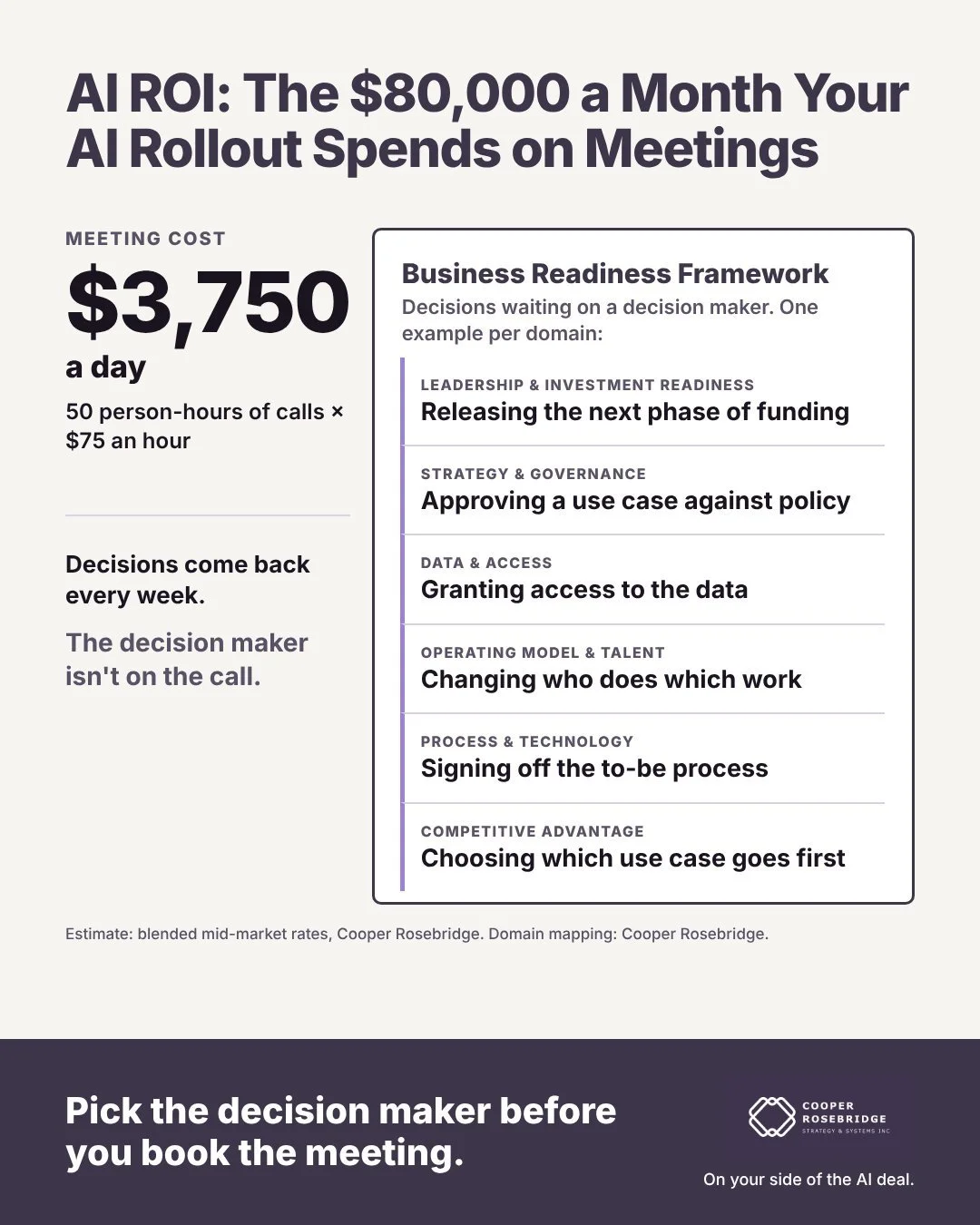
Using blended average rates across those roles, I estimate the cost at $75 per person-hour. An active implementation runs on about 50 person-hours of calls a day. That’s $3,750 a day, or close to $80,000 a month. A lighter rollout runs nearer $1,875 a day, and an intensive testing phase can climb to $7,500.
That cost sits in the OpEx of every department on the call, separate from vendor quotes and formal project budgets. Meanwhile, your expected payback period moves further away each week a key decision sits unmade.
Trace stalled decisions to business readiness debt
Business readiness debt is every readiness step a company skipped each time it rolled out technology. Assigning explicit decision ownership is often the first step omitted, leaving teams to rely on consensus and additional meetings.
AI pulls legal, compliance and data into decisions that used to sit with IT and the business, so every stalled decision now takes more people's time. The topic returns each week because the group wants consensus before committing, the person who can decide isn't on the call and half the attendees are doing other work. You've heard how those calls end: let's pick this up next week once finance weighs in.
The people on those calls aren’t the problem, they are advocating for their own area. Each one also has a full-time job, so the gaps between departmental responsibilities remain unaddressed.
Close gaps with an owner, a target, and a date
Internal teams rarely see these structural gaps because each leader focuses on their unit, and standard software sales processes do not highlight them. Cooper Rosebridge Strategy and Systems Inc identifies and resolves these gaps before they create project delays.
I start with three roles:
Project sponsor: approves the budget, then moves to the next priority. That funding gets tied to a financial target the sponsor already reports, with a date to check it.
Business owner: carries the result without the authority to make the calls. Each decision gets one owner, a target and a pass-or-fail test.
PMO: tracks tasks. That tracking gets connected to the return you approved, so your team sees a miss while there’s still time to fix it.
Then every open decision gets one decision maker. A few examples by domain:
Leadership & Investment Readiness: releasing the next phase of funding.
Strategy & Governance: approving a use case against policy.
Data & Access: granting access to the data.
Operating Model & Talent: changing who does which work.
Process & Technology: signing off the to-be process.
Competitive Advantage: choosing which use case goes first.
Sometimes the right answer is to wait. If a decision the AI depends on has no owner, I’ll tell you to pause the spend, what to fix first and how to fit it. A paused project costs less than one that meets every day and decides nothing.
Start with one week of tracking. For every AI meeting, count how many people joined, how many spoke and how many decisions got made. If the decision count stays at zero, you’ve found where your rollout’s money goes.
Every meeting that ends without a decision costs OpEx and moves your payback date out. One decider per decision, with input gathered ahead, gets your teams off the calls and your AI earning back its cost sooner.
Pick the decision maker before you book the meeting.
Want to see where your gaps are? The free, 3-minute AI ROI Quick Check reviews one workflow for gaps in ownership, sign-off and measurement, and shows you the biggest one. Already have a vendor proposal on the table? Message me for an AI ROI Vendor Business Case Review.
Andrea Lazaru, Cooper Rosebridge
On your side of the AI deal
FAQ
Doesn’t consensus build buy-in?
Buy-in comes from being heard and seeing the decision made on time. Gather input early, then let one role decide.
Who should make AI decisions?
The role accountable for the result decides. The business owner decides on process changes, and the project sponsor decides on funding.
What if the decider can’t make the meeting?
Move it. A meeting without the decider produces another meeting.
Is $75 an hour right for my company?
Use your own blended rate. The math works the same way.
About the Author
Andrea Lazaru
Founder and President, Cooper Rosebridge Strategy & Systems Inc.
Spent 15 years on the vendor side of enterprise SaaS focused on post-implementation ROI.
Worked with customers from every industry, ranging from 50 to over 100,000 employees.
As a senior leader and technology buyer at a healthcare organization, built a business transformation department from the ground up.
Owned the program budget and led organizational change across 10,000 clinical employees.
Holds an MBA in Management and Change.
Helped teach a graduate course in corporate governance and accountability.
Serves as an independent advisor to mid-market executives who are looking for AI ROI.
Sells no software, takes no referral fees and accepts no implementation work.
Leads every engagement personally and takes at most two clients at a time.
