
Which Business Objective Is Your AI Built to Support?
Your AI investment should anchor to a business objective your company already has, and your vendor must align to it.
Last week, I wrote about why AI initiatives stall: vendors sell software licenses, implementation partners bill hours, and the operational outcome is left with your team.
How can you get ahead of this? I’ve defined six core domains organizations must evaluate before spending on their next technology investment.
Leadership & Investment Readiness
Strategy & Governance
Data & Access
Operating Model & Talent
Process & Technology
Competitive Advantage
This week focuses on Investment Readiness. Over 15 years in enterprise technology, I’ve found this factor is the earliest predictor of whether an AI initiative delivers measurable return.
Is your AI purchase tied to existing strategic targets?
Your strategic plan already dictates your primary objectives: revenue growth, cost reduction, margin expansion, or market share. Was your last AI purchase explicitly tied to one of those line items? Can your leadership team point to the result?
If the objective is cost management, your AI investment should target a specific line-item cost: like cost per processed invoice, and define how far that unit cost must drop.
BCG's Applied AI Index (surveying 1,300+ senior executives) found that the top 7.5% of AI-mature organizations focus AI on top enterprise priorities, mandate explicit C-suite oversight, and measure value directly on the P&L. The result? They realize three times the value of companies without formal value tracking.
How does an AI proposal get built?
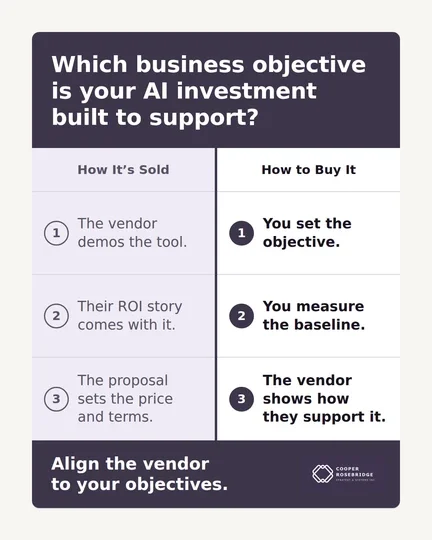
Standard enterprise procurement follows a predictable script: the vendor demos the tool, attaches an ROI narrative, and submits a proposal defining software tiers, implementation costs, and service levels.
As both a vendor and a buyer, I saw how those ROI stories come together under tight sales deadlines: general industry benchmarks, estimates from quick discovery calls and metrics your organization doesn’t currently measure
You're being sold a sequence centered on the vendor's software. The fix is to shift the focus from their product to your business outcomes.
What happens when the vendor’s ROI story becomes your business case?
When no internal business case exists, the vendor’s estimated ROI story becomes your default benchmark. Success is then measured against vendor assumptions rather than your actual financial metrics.
Meanwhile, your team plans to measure value once it goes live. Without a baseline built from several months of data before go-live, there’s nothing to compare against. Six months after launch, your dashboard tracks user logins and adoption rates, and neither is a financial KPI.
If hours saved is defined after deployment, any outcome can be reported as a win. An operational team counts hours saved as automated processing time. Finance counts it only if payroll expense declines. And can the team take on more work with the time saved? The same initiative looks like a success or a failure depending on which definition the report uses. Step 3 below fixes this.
What does the proposal’s TCO leave out?
Total Cost of Ownership (TCO) in a vendor proposal usually covers licenses and deployment. It leaves out the operational readiness work required before software generates value: assigning data owners, setting usage policies and adjusting the operational targets of the teams that use it.
I call this gap business readiness debt: every readiness step a company skipped each time it rolled out technology. The steps skipped during your CRM or ERP rollouts show up as unbudgeted costs on your AI project. Step 4 below puts them in the budget.
Where does the cost show up?
Budget variances: readiness work discovered after signing becomes an unbudgeted expense on a project approved without it.
Executive risk: AI results reported to leadership rest on vendor estimates, which puts the program at risk in every spend review.
Strategic stagnation: BCG found the most AI-mature companies deliver 2.4 times the top-line growth of companies in the bottom half of its sample. So if you can’t measure the return, you can’t tell which AI initiatives deserve more investment.
You can avoid these costs if the baseline work happens before the contract is executed.
How do you align the vendor to your objective?
A 4-Step Framework for Vendor Alignment
Flip the sequence. Complete these four steps before scheduling the vendor demo, then require the vendor to align to them:
Define the Objective: Pick a strategic target, such as cost management, and set a KPI target, such as invoice processing cost down by a set percentage within 12 months.
Assign One Executive Owner: Make one executive accountable for the outcome after the implementation partner leaves, such as the CFO for cost reduction or the head of sales for revenue growth.
Establish Baselines & Definitions: Calculate the current value of the KPI from existing internal reports. Agree on what key terms mean before signing, such as how hours saved turns into bottom-line value. If the baseline report doesn’t exist, build it first.
Scope the Full Readiness Cost: Include all internal readiness work in your total budget alongside licensing and implementation.
Then bring in the vendor. Require them to show how their technology moves your KPI from its baseline, specify the readiness work it requires and agree to be measured against your definitions.
When should you wait to sign?
Pause procurement if:
The core objective, executive owner, or baseline data is missing.
Operational readiness work is left out of the financial plan.
Measuring baselines up front may delay contract signing. But signing without them guarantees you cannot prove return. This leaves leadership unable to determine whether to scale the software or terminate it. Use the delay to assign data owners, enforce governance, and establish baseline numbers.
How do you test your last AI purchase?
Pull the business case for your organization’s most recent AI purchase. Identify the objective it states and the baseline it started from. Ask your team to calculate that baseline today using a report currently in production. If they can’t, you’ve found your first gap to close.
Align the vendor to your objectives.
Next week, I’ll continue with Leadership & Investment Readiness by breaking down the cost side: exactly what belongs in the TCO of an AI investment.
Until then, take the free, 3-minute AI ROI Quick Check.
FAQ
Can we use the vendor’s ROI model as our business case?
Use it as one input. Your business case needs your own targets, your measured baselines and your complete readiness costs.
What if we don’t have a baseline today?
Build it before signing. If the underlying data doesn’t exist, closing that gap is your first priority and a clear signal to pause procurement.
What’s the difference between a business objective and a KPI?
The objective is what the business is trying to achieve, such as cost management. The KPI measures progress toward it, such as cost per processed invoice. AI supports the objective, and the KPI shows whether it worked.
Doesn’t waiting to sign delay value?
It delays kickoff. Moving forward without a baseline leaves leadership with no way to judge performance, so there’s no basis to scale the tool or cut it.
About the Author
Andrea Lazaru is the founder and president of Cooper Rosebridge Strategy & Systems Inc. She spent 15 years on the vendor side of enterprise SaaS, helping technology buyers realize full value from their investments across organizations ranging from 50 to over 100,000 employees. She later served as a senior leader at a healthcare organization, building a business transformation department from scratch, managing program budgets, and leading change across 10,000 clinical employees. Andrea holds an MBA in Management and Change and serves as an independent advisor to mid-market executives looking for AI ROI. She sells no software, takes no referral fees, leads every engagement personally, and works with a maximum of two clients at a time.
