
How to evaluate customer service AI before you fund an initiative that misses its business case.
Only 4% of customer service organizations have achieved the ROI they expected from AI, according to a Gartner survey of 275 service and support leaders. Customer service is the use case vendors pitch as the easy start. So when the easy start misses its business case, every other AI idea on your list gets harder to fund.
Below are the six areas that decide whether service AI delivers ROI, and one test to run first.
The entry-level AI use case has a low return
The pitch is simple: a ticket comes in, AI answers it and the cost per ticket drops. The demo proves the software can do that. What it can’t show is what the software has to work with inside your operation: undocumented exceptions, an outdated knowledge base and senior agents who know which customers to escalate.
Gartner found that AI-forward service organizations invest nearly 1.8 times more in data and knowledge foundations than in the AI use cases themselves. So the return depends on readiness work, and that work rarely appears in a vendor’s proposal. Leave it out of the business case, and the payback period looks shorter than it will be.
Then comes the question no executive wants: If we can’t make the easy one pay, what happens to the rest of the portfolio?
Before you fund service AI, ask your project sponsor to show you the budget line for readiness work, with its own owner and dollar amount. If there isn’t one, the business case is incomplete.
Business readiness debt decides whether service AI delivers ROI
I spent 15 years at Salesforce making sure customers got value from their software after go-live. Across those 200+ engagements, when the return fell short, the technology was rarely the main issue. The cost came from business readiness debt: every readiness step a company skipped each time it rolled out technology. With earlier software, teams covered the skipped steps with workarounds. AI hits the same debt, only faster, because it acts on your process and data directly.
In customer service, each area sets its own standard.
Leadership & Investment. One executive sponsor owns the service AI outcome, from cost per ticket to customer retention, and holds the authority to fund, pause or stop it. The sponsor agrees in advance on intervention triggers: a decision stalled past a set deadline, a budget overrun, or forecast value falling below target. The investment rests on a business case with a measured baseline, so AI ROI is a reported result, not a vendor estimate.
Strategy & Governance. Customer service AI earns its place in the portfolio on a quantified value hypothesis, ranked against every other AI idea competing for the same budget. Leaders decide before launch which ticket types are too sensitive to automate, what customer data the AI can use, and the conditions under which it won’t go live. Agents can report a wrong AI answer without blame, so problems surface while they’re cheap to fix.
Data & Access. The knowledge base and ticket history each have an accountable business owner and a quality standard the AI depends on. Service and Finance agree on what resolved and cost per ticket mean, so both calculate the same result. One north-star KPI, backed by guardrail metrics such as escalation rate and customer satisfaction, flags a slipping return early, and leadership sees adoption, reliability, risk and cost on one page.
Operating Model & Talent. A signed decision-rights policy sets when an agent can override the AI and who has final say. The rollout moves team by team, and each stage passes evidence-based acceptance criteria before the next begins. Managers get talk tracks and a first-week coaching plan before launch, AI training completion is tracked against total headcount, and every person who keeps the system running has a trained backup.
Process & Technology. Escalation and exception rules sit in a runbook a new agent could follow, because AI can only automate rules that are documented. Every AI conversation records directly into the CRM, so sales and account teams see the same customer history. A tested off switch returns tickets to agents if the AI fails, and a qualified backup vendor protects the service if the primary one does.
Competitive Advantage. Your senior agents’ judgment on difficult cases is captured in the knowledge base, so it stays in the company when they leave. Ticket patterns feed product and market decisions, with one owner accountable for turning them into intelligence, and access to that data is tighter than standard because it reflects your customer relationships. Every failed change is recorded with what was tested and what happened, so the next team doesn’t repeat it.
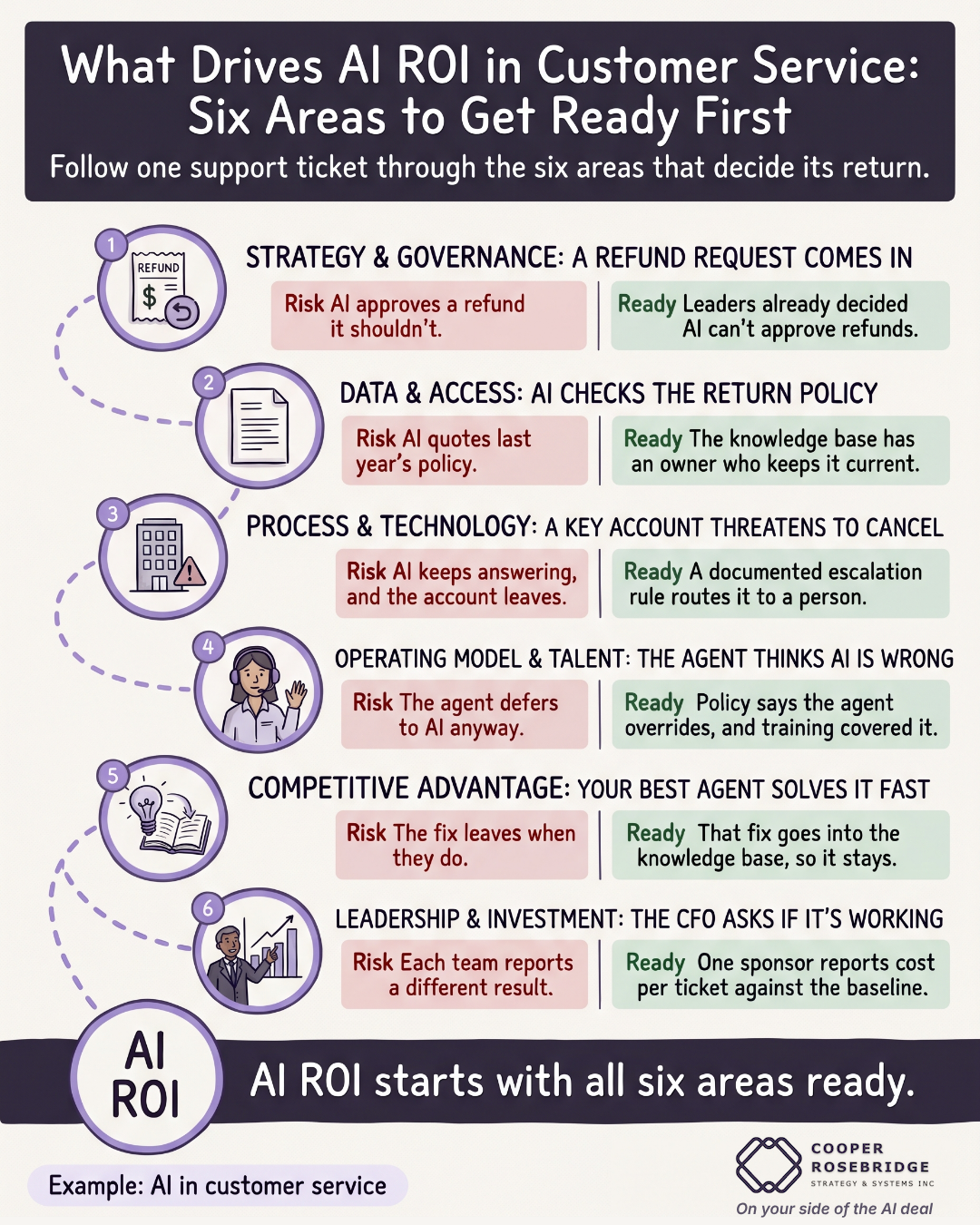
Path of one support ticket through six areas, each with a risk and a ready step, ending at AI ROI.
Test one area before you approve the next AI idea
Start with Process & Technology, because AI can only follow rules that exist.
Ask your process owner how the last ten escalated tickets were decided, and who decided each one. Escalations are your exceptions, and AI needs the same rules your senior agents use. If the answer comes back in a day, the rules exist. If it takes a week, they live in people’s heads, and AI will guess.
A week-long answer changes the business case. Documenting those rules becomes readiness work with its own cost and timeline, and the payback period moves with it.
That’s what Get Ready does across all six areas. I tie each AI idea to a KPI you already report, test it against the six areas and put the fixes in order. If an idea isn’t ready, you hear it before you spend, along with what to fix first.
Customer service looks like the safe first bet, which is why its 4% result deserves attention. The return depends on whether leadership, governance, data, people, process and know-how are ready to support it. Ready those six areas first, and the easy use case becomes the proof point that funds the rest.
AI ROI starts with all six areas ready.
Which of your AI investments will pay off? I give you an independent answer, then lead the business side alongside your team until they own the return.
Book a 20-minute call and bring one AI idea. Not ready to talk? The free, 3-minute AI ROI Quick Check shows where one workflow stands.
Andrea Lazaru, Cooper Rosebridge
On your side of the AI deal
FAQ
Is customer service a bad place to start with AI?
It’s a strong candidate when the knowledge base, escalation rules and data owners are in place. The risk is skipping that work.
Do we need all six areas ready before any AI project?
Each AI idea depends on some areas more than others. Get Ready shows which areas this idea needs and the order to fix them in.
We’ve already launched service AI. Is it too late?
No. Start by rebuilding the business case against a measured baseline, then fix the areas holding the return back.
About the Author
Andrea Lazaru is the founder and president of Cooper Rosebridge Strategy & Systems Inc. She spent 15 years on the vendor side of enterprise SaaS, helping technology buyers realize full value from their investments across organizations ranging from 50 to over 100,000 employees. She later served as a senior leader at a healthcare organization, building a business transformation department from scratch, managing program budgets, and leading change across 10,000 clinical employees. Andrea holds an MBA in Management and Change and serves as an independent advisor to mid-market executives looking for AI ROI. She sells no software, takes no referral fees, leads every engagement personally, and works with a maximum of two clients at a time.
