
For mid-market CEOs, CFOs and COOs: what an AI rollout really costs, and how to price it.
BCG found that 80% of AI spending sits outside the enterprise IT budget. So if you judge AI ROI from the IT budget, you're judging it on part of the cost.
That figure comes from a BCG survey of more than 1,300 executives. The rest of the cost sits in two places:
Business unit budgets, where many AI tools get funded
Your team's time, which rarely shows up as spending
The vendor's quote prices the software and outside implementation help accurately. Your internal work is a separate cost, and many business cases leave out at least some of it.
If you're setting next year's budget now, this cost belongs in that budget.
The quote is only part of the cost
Internal work is hard to price because it arrives as hours, spread across people who already have full-time jobs:
A finance lead building the baseline
A manager redesigning a workflow
Staff learning a new process while they still run the old one
Those hours come out of existing salaries. So the business case treats them as free.
Here's the scale. The free AI TCO Calculator gives this starting estimate for a customer-facing AI tool at $3,000 a month, used by 18 staff and connected to 2 systems:
Starting 3-year TCO estimate: $167,400
Direct costs: $115,500 for the subscription, setup and legal fees
Usage fees: none in this example, because the price was a flat monthly fee
Internal labor: $51,900, or 1,090 hours of staff time
Many AI tools also bill by usage: tokens, messages or credits. If yours does, ask the vendor for 12 months of expected usage and add it.
Where those 1,090 hours go:
Before the contract
Business case and baseline, 40 hours: clear business goals, success measures and leadership sign-off
Pilot and rollout
Ownership and work design, 50 hours: accountability, responsible-use policies and new ways of working
Data and systems, 60 hours: accurate, accessible data that works with your current systems
Training and adoption, 270 hours: training, guidance and change management for every user
After go-live
Upkeep and support, 210 hours: updates, fixes and ongoing help for your team
Results tracking, 460 hours: checking AI output, and tracking results against your goals and baseline
These are planning estimates. They vary by company size, industry and use case.
The takeaway: if the business case has no line for internal labor or usage, the TCO is incomplete.
Some costs you need to estimate yourself
The starting estimate leaves out costs that vary too much by company for any calculator to estimate fairly. Your full TCO is the starting estimate plus a figure for each cost below. Enter them in the calculator's detailed assessment, and it adds them to your total as Costs you estimated. A rough figure beats a blank line in the business case.
Business side
Project management and testing
Security, privacy and compliance, including insurance changes
Governance and monitoring after go-live, including AI errors and any customer remediation
Change management beyond training, including staff turnover
Vendor management: premium support, change orders, renewal and exit
Staffing and travel: new roles, contractors, overtime and travel
Technology side
Extra technology: integration tools, storage, devices and translation
Then add your usual contingency for overruns.
The takeaway: send this list to your project sponsor, and ask for a figure on every line.
Business readiness debt makes skipping this work expensive
I spent 15 years at Salesforce helping customers get value from their software after go-live, across more than 200 engagements. The companies that got value planned for the internal work as well.
The others built up business readiness debt: every readiness step a company skipped each time it rolled out technology.
Here's how that debt behaves:
With earlier software, teams covered the skipped steps with workarounds. A manager fixed the data manually. A senior employee knew every exception.
With AI, the tool acts on your process and data directly, at speed and at scale. So a missing data owner or an undocumented exception surfaces within weeks, as rework and delay.
Rework after launch costs more, because the rollout is live and the team is already behind schedule.
The takeaway: price the readiness work before signature, while it's still at its lowest cost.
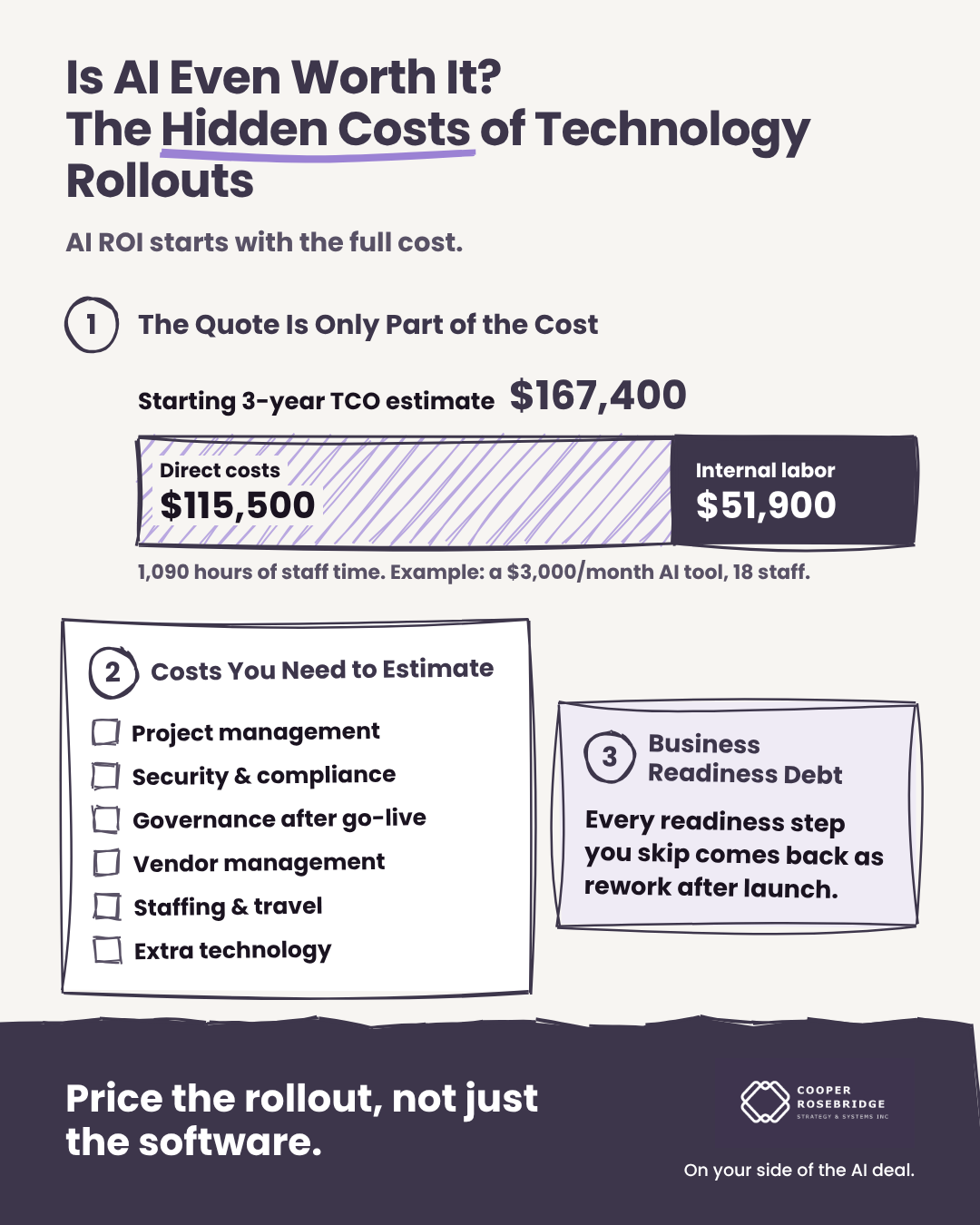
A $167,400 starting 3-year AI TCO estimate, split into direct costs and internal labor, plus costs to estimate
Before you sign, do three things:
Run the free AI TCO Calculator with the vendor's price and your team size.
Get a figure for every cost on the list above from your team and your IT lead.
Put each cost in the business case as its own line, with an owner.
Is AI worth it for your company? The answer starts with the full cost of the rollout. Price all of it, and the business case gives you an honest payback period.
Price the rollout, not just the software.
Which of your AI investments will pay off? I give you an independent answer, then lead the business side alongside your team until they're ready to run it.
Have a vendor proposal on your desk? Book a 20-minute call and bring it. I'll walk you through what a Vendor Proposal Review tests: the vendor's full cost and payback period, against your own baseline, before signature.
Not ready to talk? The free AI TCO Calculator estimates the 3-year cost of one AI tool. Four questions, and no email needed.
Andrea Lazaru, Cooper Rosebridge On your side of the AI deal
FAQ
Why is internal labor so hard to price?
It comes out of existing salaries, so it never shows up as AI spending. The hours depend on your data, your processes and the number of staff using the tool.
Is the calculator's estimate right for my company?
It's a starting estimate, based on cost estimates from industry research, government data and real-world experience. Adjust any figure to match your company, or bring the result to a 20-minute call.
Does a high TCO rule out the purchase?
No. It means the business case has to cover the full cost. A Vendor Proposal Review tests the vendor's case against that full cost and your own baseline, before signature.
About the Author
Andrea Lazaru is the founder and president of Cooper Rosebridge Strategy & Systems Inc. She spent 15 years on the vendor side of enterprise SaaS, helping technology buyers get the full value of their investments. Her customers came from every industry and ranged from 50 to over 100,000 employees. She then became a senior leader at a healthcare organization, where she built a business transformation department from the ground up, owned the program budget and led organizational change across 10,000 clinical employees. Andrea holds an MBA in Management and Change and serves as an independent advisor to mid-market executives who are looking for AI ROI. She sells no software, takes no referral fees and accepts no implementation work. She leads every engagement personally.
